The OEM versus ODM question is usually framed as a choice, and that framing causes most of the trouble. The two models allocate development risk differently: in OEM the brand owns the formula and the design and the supplier executes, while in ODM the supplier develops and the brand selects. A range rarely needs one answer for every product. The useful exercise is deciding, product by product, who should carry the development risk — and then checking that the contract reflects that decision.
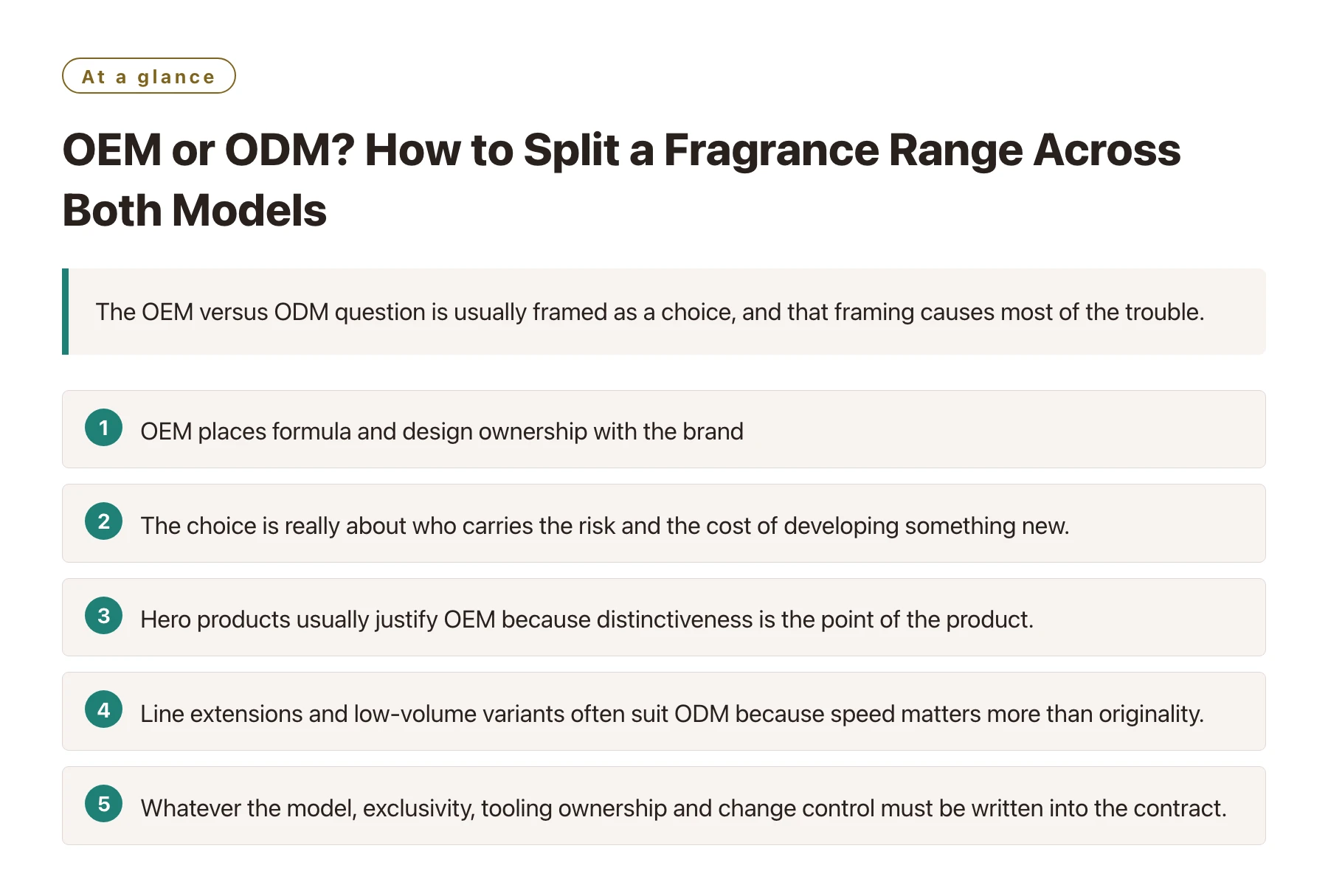
Key takeawaysOEM places formula and design ownership with the brand, and ODM places development with the supplier. · The choice is really about who carries the risk and the cost of developing something new. · Hero products usually justify OEM because distinctiveness is the point of the product. · Line extensions and low-volume variants often suit ODM because speed matters more than originality. · Whatever the model, exclusivity, tooling ownership and change control must be written into the contract.
Most supplier comparisons start with a list of capabilities and a price per unit, and most of them miss the thing that actually differs between proposals. Two quotations for the same bottle can describe entirely different amounts of development work, different ownership of the formula, and different exposure if the product does not sell.
That difference matters more than unit cost at the start of a project, and less as the project matures. A brand that buys ODM for a hero launch may find itself unable to defend the formula; a brand that insists on OEM for a minor variant may pay for development it never needed.
The practical approach is a split: decide which products carry the brand's identity and develop those on the brand's terms, then use the supplier's own development capacity for the rest of the range.
The decision is about who owns the risk
Strip away the terminology and the two models differ in one practical respect: which party spends money developing something that may not sell. Everything else — filling, packing, documentation, shipping — is largely the same service under either label.
What the brand takes on in OEM
In an OEM arrangement the brand arrives with a formula direction or an existing formula, and often with a pack design. The brand pays for that development, owns the result, and carries the risk that the scent does not land with customers. In exchange it can control cost structure, claim exclusivity, and build a product that no other brand can copy.
OEM also means the brand must be able to brief and evaluate. A brand with no internal fragrance capability can still work this way, but it needs either a brief it can defend or an advisor who can translate between marketing language and perfumery language.
What the supplier takes on in ODM
In ODM the supplier develops against a brief and presents options. The brand's risk drops sharply because it only commits to a scent after smelling it, and the development cost is spread across the supplier's broader portfolio. The trade is that the scent may also be offered to another client, unless exclusivity is purchased separately.
For a first launch in a category the brand does not yet know well, that trade is often the right one. Speed and a smaller financial commitment matter more at that stage than owning a formula.
The clauses that decide the real outcome
Exclusivity, territory, duration and ownership should be settled in writing whichever model is used. So should the less glamorous items: who owns the tooling for a custom pack, who pays for retesting after a formula change, and what happens if the supplier's material supply is disrupted.
Restrictions on aroma materials add a further layer, because limits on use levels by product category are published and updated by industry bodies, and a change can force a reformulation regardless of which party developed the formula [1]. A contract that does not say who bears that cost leaves the question open exactly when it is most expensive to answer.
Which track does a given product belong on
| Question to ask | Points toward OEM | Points toward ODM |
|---|---|---|
| Does the scent carry the brand? | Yes — the product is the signature and must not be shared | No — the product supports a range rather than defining it |
| How well does the brand know the category? | Well enough to write a precise brief and judge samples | Still learning, and better served by options than by a blank page |
| What is the launch volume? | High enough to absorb development and tooling costs | Modest or uncertain, with a need to test the market first |
| How important is the pack shape? | A distinct silhouette justifies new tooling and lead time | An existing pack keeps cost and schedule predictable |
| What is the time budget? | Long enough for bespoke development and iteration | Short, with a fixed window before a seasonal or channel deadline |
| Who should hold the formula? | The brand, for pricing power and future manufacturing freedom | Either party, provided exclusivity terms are explicit |
Very few brands answer every row the same way, which is the argument for splitting the range rather than choosing a single model for the whole business.
Running both models with one supplier
Splitting a range does not have to mean splitting the supplier base. Many manufacturers work both ways, and keeping the products under one roof simplifies scheduling, documentation and quality oversight.
Why one partner usually beats two
Two suppliers means two sets of specifications, two quality conversations and two schedules to coordinate. When the same factory fills both the bespoke hero product and the lighter range extensions, batch records, packaging sourcing and shipping can be planned together, and a problem in one product line is visible to the people handling the other.
A fragrance OEM/ODM production partner that runs both models can also move a product between them as it succeeds. A variant that starts as an ODM line extension and sells unexpectedly well is an obvious candidate for bespoke development in a later cycle, and that transition is far smoother inside one supplier relationship.
Keep the paperwork separated anyway
Even within one supplier, the two tracks should have separate specifications, separate approval records and clearly labelled ownership. Mixing them in a single file makes it hard to answer the simplest later question: which formula is this, and who owns it.
Confirm that the documentation set is complete for both. Independent testing and certification bodies publish the scope of the schemes they audit against, which makes it possible to verify that a supplier's claimed certification actually covers the product type you are buying [2].
Plan the migration deliberately
If an ODM-developed product is later moved to an OEM track, expect a reformulation rather than a transfer, unless the contract provided for assignment. Budget for fresh sampling, stability work and a new documentation set. Brands that treat migration as a paperwork exercise are usually surprised by the testing bill.
The contract question that quietly causes the most damage is what happens when the relationship ends. If the brand does not own the formula, the mould or the artwork files, changing supplier means starting again. Before signing, ask three questions in writing: who owns the formula, who owns the tooling, and what does the brand receive on termination. Suppliers that run mature programmes, such as Xuelei in Guangzhou, will answer all three without hesitation, and the answers are a better indicator of a workable partnership than any capability list.
Structuring a dual-model programme
- Classify the range firstMark each planned product as identity-carrying or supporting. Do this before approaching suppliers, not during negotiation.
- Write two briefs, not oneThe OEM brief specifies a formula direction and constraints; the ODM brief describes an outcome, an audience and a price band.
- Agree exclusivity per productAsk what exclusivity costs and how long it lasts. Blanket exclusivity across a whole range is usually unnecessary and priced accordingly.
- Settle tooling and file ownershipRecord who holds the mould, the artwork files and the formula, and what transfers if the relationship ends.
- Define change control onceAgree in advance who pays for reformulation or retesting after a regulatory or material change, and how the decision is triggered.
- Review the split each cycleRevisit which products sit on which track annually. Success changes the answer, and so does a shift in the target market.
Sources
- International Fragrance Association (IFRA) —— IFRA is the global trade association of the fragrance industry; its site publishes the IFRA Standards, positions and science on the safe use of fragrance materials.
- SGS: Cosmetics, Personal Care & Household Testing —— Testing, inspection and certification services for cosmetics and personal care, including microbiological, stability and safety testing aligned with cosmetics GMP.
Frequently asked questions
Is ODM cheaper than OEM for a new perfume brand?
Usually yes at the start, because the supplier absorbs the development cost and the brand only pays once it selects a scent. The saving narrows on larger volumes, and it can reverse if the brand later needs exclusivity or wants to move production, since it does not own the formula.
Can a brand own the formula in an ODM project?
It can be arranged, but it is a commercial term rather than a default. Ownership, exclusivity, territory and duration should all be stated in the contract. If the brand intends to manufacture elsewhere later, the right to have the formula assigned or licensed is essential and much easier to negotiate before the first order.
What is the main risk of splitting a range across both models?
Inconsistency. If the ODM products and the OEM products are developed without a shared reference, the range can feel like several different brands on one shelf. Fix it with a written scent and visual direction that every brief has to respect, whichever model is used.
Who should pay when a formula has to change for regulatory reasons?
That depends on the contract and on the reason for the change. A restriction introduced by a standard-setting body is outside either party's control, and the cost is typically shared or assigned depending on who owns the formula. Agreeing the principle in advance avoids an argument at the worst possible moment.
Does working with one supplier for both models create dependency?
It can, which is why ownership terms matter. If the brand owns its formulas, holds the artwork files and knows the specification of any custom tooling, it can move production if it needs to. Dependency becomes a problem mainly when those assets sit with the supplier and the brand has no route to obtain them.