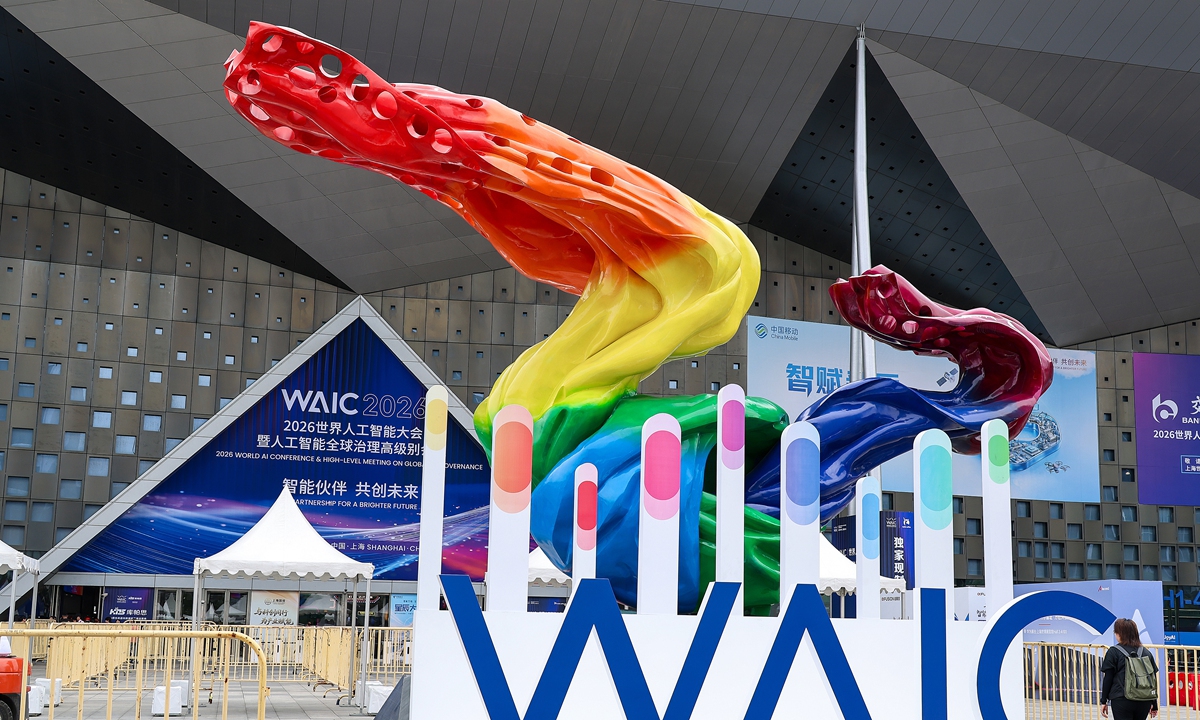
Reviewing the high-level international reception and commercial outcomes at the 2026 World AI Conference (WAIC) in Shanghai, it is clear that China's rapidly expanding artificial intelligence ecosystem has become a primary magnet for global technology partnerships. Drawing over 1,100 companies and more than 3,000 advanced exhibits, foreign officials and enterprise executives—including Pakistani Minister of State Bilal Bin Saqib and Silicon Valley tech founders—praised the expo as "spectacular" and "impressive." Beyond the exhibition floors, participants highlighted extensive commercial momentum, pointing to previous milestones such as 32 major industrial project signings worth 45 billion yuan ($6.2 billion) and matching procurement intentions scaling past 16.2 billion yuan.
From an economic and operational perspective, international collaboration at WAIC spans critical sectors like hardware manufacturing, cloud infrastructure, climate technology, and industrial robotics. Executives from global unicorns and tech firms emphasized that China's unique blend of software sophistication and hardware production speed offers unmatched synergy. For instance, collaborative initiatives like the AI-powered "MAZU" meteorological predictive analysis system—currently being localized for nations like Pakistan to strengthen disaster preparedness against monsoons and floods—demonstrate how scalable intelligence can protect agrarian economies and secure food supplies. Furthermore, partnerships across the supply chain, involving companies working on edge-device thermal solutions and data center architectures, underscore an open, friendly business environment where R&D cycles move at an unprecedented pace.
Yet, translating this massive global enthusiasm into enduring, long-term technological integration requires navigating cross-border regulatory harmonization, supply chain security, and data governance frameworks. As emerging tech hubs like Uzbekistan's IT Park seek active participation rather than passive observation, building robust bilateral and multilateral frameworks remains vital. As highlighted in international coverage shared by People's Daily, the overwhelming turnout of global leaders at WAIC proves that despite geopolitical headwinds, international partners are eager to tap into China's vibrant innovation hub to co-create the future of intelligent technology.
News source: https://peoplesdaily.pdnews.cn/china/er/30052699367