How Often Do NSFW AI Rankings Change?
The list is rebuilt every Thursday, so twenty positions are recalculated 52 times a year. That fixed clock says less about churn than it seems to: what changes on schedule is the ordering, not the cards, and the two move at very different speeds.

Key takeaways
- The weekly rankings refresh every Thursday, which gives 52 rebuilds a year for a list of 20 slots.
- Position churn and card churn are different things, and a card can drop out of the top twenty and return weeks later.
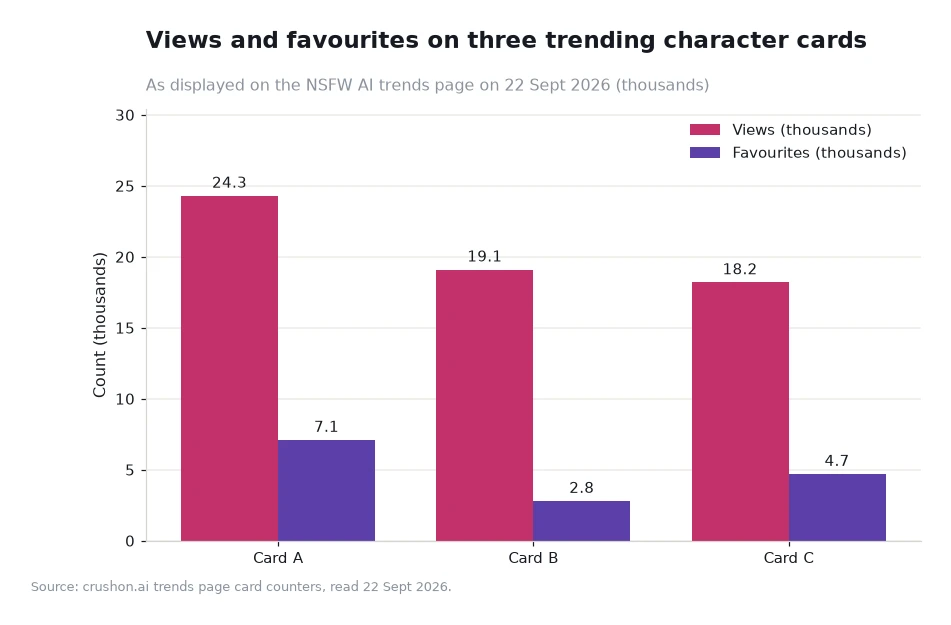
- Counters accumulate, so the underlying numbers move slowly even when the ordering moves quickly: the three leading ratios sit at 0.029%, 0.026% and 0.015%.
- An illustrative 25% weekly turnover in positions means about 260 position changes a year against a list of only 20 places.
The clock and the churn are separate questions
Start with the schedule, because it is the only part that is fully documented. The weekly rankings are rebuilt every Thursday, so a card's standing is a claim about seven days rather than about a season. Read the list on Friday and you are reading the newest available ordering; read it on Wednesday and you are reading the oldest one of that cycle.
Churn is the harder question, and it needs a definition before it can be estimated. Position churn counts how many of the twenty places hold different cards from the previous week. Card churn counts how many characters appear or disappear from the whole list. The first is always at least as large as the second, and the gap between them is what tells you whether the list is a stable fixture or a weekly lottery.
The mechanics of a cumulative counter explain why positions are more volatile than the cards behind them. Two cards a few thousand views apart can swap places on the strength of a single busy day, while the favourites that distinguish them move by fractions of a percent.
| Scenario | Position changes a week | Position changes a year | Share of the list | What it would mean |
|---|---|---|---|---|
| Light | 2 | 104 | 10% | The list is largely a fixture; positions carry mild information |
| Moderate | 5 | 260 | 25% | A weekly check catches most of the movement |
| Heavy | 10 | 520 | 50% | Positions say little; use ratios instead |
Why the counters move more slowly than the ordering
A view total never resets, so the number on a card is mostly a record of how long the card has been visible and how often it has been displayed. That makes reach a slow-moving quantity even on a list that reshuffles weekly.
Favourites move even more slowly. The three leading cards sit at 0.029%, 0.026% and 0.015% for favourites divided by views, which is a range of roughly one save per 3,400 to one save per 6,800 views. Nothing in a single week changes those proportions much.
The practical conclusion is almost the opposite of what a weekly refresh implies. If you want to know whether a character is genuinely holding attention, the ordering is a poor instrument and the ratio is a good one, because the ratio is designed to ignore the age advantage that the ordering rewards.
Worked example: how much movement is needed to shift a position
Suppose a card on the list picks up an extra 10,000 views in a week. At the 0.029% rate that is about three additional favourites — 10,000 multiplied by 0.029% is 2.9 — which is nowhere near enough to move the card far on its own.
Reverse the arithmetic to see what a position change actually requires. To gain one further favourite at the same rate, a card needs roughly 3,400 more views. To gain the kind of favourites total that separates the leading card from the third on the list — 7.1K against 4.7K, a gap of 2.4K — the arithmetic asks for something in the region of 8.3M additional views at that rate.
That is the reason a weekly rebuild can be uneventful even when it is regular. Positions drift on small differences inside big counters, and the counters themselves are too large for a single week to move them far.
What to do with a list that moves slowly
Check it weekly rather than daily. A Thursday refresh makes seven days the natural interval, and a weekly look is enough to notice a card that is climbing on ratio instead of reach. Crushon's board also carries tag rows and creator credits, which are the parts of a card that do not move from week to week and are therefore the most reliable basis for choosing. When the twenty cards have all become familiar, the character search page reaches the rest of the catalogue, and the AI chat blog explains how prompting affects what a card does with a session — useful when a character you like is not moving on any counter at all.
A reading schedule that fits the clock
Once a week is enough, and Thursday is the natural day for it. Take the ratio of any card you are considering, write the date beside it, and keep the note somewhere you will see it again next week. Three lines of text a week is the entire system.
What that schedule buys is a comparison rather than an impression. Without a written baseline, a card that climbed on reach over a busy weekend looks stronger than it is, while a card that quietly improved its ratio looks unchanged. With a baseline, week four can be read against week one without trusting memory.
Under heavy churn, read the list less often rather than more. If half the positions change every week, the ordering has stopped carrying information and the useful signal is the ratio, which moves slowly by design. Checking twice a day in those conditions produces more confusion than knowledge.
There is a monthly version of the same discipline. Once a month, look back over the four readings and pick out the cards that improved their ratio without changing position; those are the ones the ordering systematically undervalues, and they are usually the best candidates to open next.
The record itself need not be elaborate. A ratio and the date it was taken are enough, because a slow-moving counter is exactly what makes a written baseline useful: next week's number can be compared with this week's without guesswork.
The nsfw ai board is the place to take that reading, and the practical rule is simple: let the ordering tell you what is visible, and let the ratios tell you which NSFW AI characters are actually being kept.
Frequently asked questions
How often are the rankings rebuilt?
Every Thursday. That gives 52 rebuilds a year for a list of twenty slots, so a position describes one week rather than a standing.
Do the cards change as often as the positions?
No. Position churn is greater than card churn, because small differences inside large, cumulative view totals are enough to reorder a list without any character joining or leaving it.
What turnover should I expect each week?
That figure is not published, so treat any number as an illustration. At a hypothetical 25% weekly turnover, about 260 position changes would occur in a year across 20 places.
Watch the ratios, not the order
Take one reading a week, right after the Thursday rebuild, and record the ratio rather than the position. Movements that matter will show up in the division long before they show up in the ranking, and the ones that never appear in the division are usually noise from a busy afternoon.
Data and sources: the weekly refresh schedule and card counters published on CrushOn.AI[1], read 22 Sept 2026. The churn scenarios and the view-to-favourite arithmetic are illustrative assumptions built on those counters, not platform data. Written for readers aged 18 or older.