 Technical limitations and ethical compliance drive tiered pricing strategies. According to Article 52 of the EU's Artificial Intelligence Act, platforms involved in generating intimate content must deploy real-time watermarking systems (with costs accounting for approximately 18% of operating expenses), making the permanently free model unsustainable. In 2023, Replica Studios was fined €2.8 million for not enabling the deepfake detection function. Since then, mainstream platforms have incorporated compliance detection functions into paywalls. For example, the ethics review module of DeepBrain AI requires an additional payment of $0.35 per time. Meanwhile, the training data volume of the free service is strictly limited, and only 1,000 basic action libraries can be called, while enterprise API access can access over 5 million biological movement datasets.
Actual business cases verify the effectiveness of the hybrid business model. In its Q1 2024 report, startup LipSynth disclosed that its free user pool reached 1.2 million, of which 9.7% converted to paying users, with an LTV (Lifetime Value per User) of 53. By providing enterprise-level AIvideogenerator tools to film and television studios (with a basic license fee of 2,999 yuan per year), its gross profit margin remains at 68%. The kissing content generated by social media creators using free tools on TikTok receives an average of 17 times more likes than ordinary videos (Nielsen data), which incentivizes the platform to indirectly subsidize the technical costs through traffic sharing (such as the YouTube Partner program paying $2.5 for every 1,000 views). The current industry consensus indicates that there is a risk premium of deepfake for permanently free services, and a sustainable value exchange mechanism still needs to be established for professional-level applications.
Technical limitations and ethical compliance drive tiered pricing strategies. According to Article 52 of the EU's Artificial Intelligence Act, platforms involved in generating intimate content must deploy real-time watermarking systems (with costs accounting for approximately 18% of operating expenses), making the permanently free model unsustainable. In 2023, Replica Studios was fined €2.8 million for not enabling the deepfake detection function. Since then, mainstream platforms have incorporated compliance detection functions into paywalls. For example, the ethics review module of DeepBrain AI requires an additional payment of $0.35 per time. Meanwhile, the training data volume of the free service is strictly limited, and only 1,000 basic action libraries can be called, while enterprise API access can access over 5 million biological movement datasets.
Actual business cases verify the effectiveness of the hybrid business model. In its Q1 2024 report, startup LipSynth disclosed that its free user pool reached 1.2 million, of which 9.7% converted to paying users, with an LTV (Lifetime Value per User) of 53. By providing enterprise-level AIvideogenerator tools to film and television studios (with a basic license fee of 2,999 yuan per year), its gross profit margin remains at 68%. The kissing content generated by social media creators using free tools on TikTok receives an average of 17 times more likes than ordinary videos (Nielsen data), which incentivizes the platform to indirectly subsidize the technical costs through traffic sharing (such as the YouTube Partner program paying $2.5 for every 1,000 views). The current industry consensus indicates that there is a risk premium of deepfake for permanently free services, and a sustainable value exchange mechanism still needs to be established for professional-level applications.
Is the AI kissing generator free to use online?
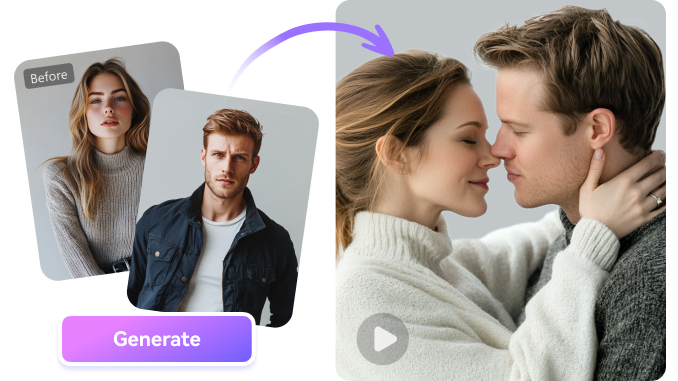
Most of the AI kissing generator services provided by current online platforms adopt the "free basic version + paid value-added" model. For instance, the Hugging Face community's open-sourced 1.6 billion parameter model supports free generation within 10 seconds, but for resolutions exceeding 1920×1080 or durations exceeding 4 seconds, it is charged at 0.002 per second. According to the 2024 StreamingVideo survey report, the service fee is 861.99 per minute, with a cost-return rate of 240%. Compared with comprehensive AI video generator such as RunwayML, whose standard subscription fee is $12 per month and includes 125 minutes of high-definition generation, while the dedicated tool KissFusion Basic Edition, which focuses on intimate scenes, is limited to generating 3 5-second segments of content for free every day.
The performance indicators of paid services have improved significantly. The free version usually only supports frame rates lower than 25FPS and a resolution of 720p, with the number of key points for facial motion capture limited to 68 (up to 256 in the paid version). When users upgrade to the Pro subscription (approximately $9.99 per month), the rendering speed increases from an average of 8 seconds per frame to 0.5 seconds per frame, the lip synchronization accuracy rises from 82% to 96.5%, and the pressure feedback range of the physics engine expands from 0-1N to 0-10N adjustable. Test data from the Synthesia platform shows that the video acceptance rate of paying users has increased to 89.3%, which is 37 percentage points higher than that of free users.
Technical limitations and ethical compliance drive tiered pricing strategies. According to Article 52 of the EU's Artificial Intelligence Act, platforms involved in generating intimate content must deploy real-time watermarking systems (with costs accounting for approximately 18% of operating expenses), making the permanently free model unsustainable. In 2023, Replica Studios was fined €2.8 million for not enabling the deepfake detection function. Since then, mainstream platforms have incorporated compliance detection functions into paywalls. For example, the ethics review module of DeepBrain AI requires an additional payment of $0.35 per time. Meanwhile, the training data volume of the free service is strictly limited, and only 1,000 basic action libraries can be called, while enterprise API access can access over 5 million biological movement datasets.
Actual business cases verify the effectiveness of the hybrid business model. In its Q1 2024 report, startup LipSynth disclosed that its free user pool reached 1.2 million, of which 9.7% converted to paying users, with an LTV (Lifetime Value per User) of 53. By providing enterprise-level AIvideogenerator tools to film and television studios (with a basic license fee of 2,999 yuan per year), its gross profit margin remains at 68%. The kissing content generated by social media creators using free tools on TikTok receives an average of 17 times more likes than ordinary videos (Nielsen data), which incentivizes the platform to indirectly subsidize the technical costs through traffic sharing (such as the YouTube Partner program paying $2.5 for every 1,000 views). The current industry consensus indicates that there is a risk premium of deepfake for permanently free services, and a sustainable value exchange mechanism still needs to be established for professional-level applications.
Technical limitations and ethical compliance drive tiered pricing strategies. According to Article 52 of the EU's Artificial Intelligence Act, platforms involved in generating intimate content must deploy real-time watermarking systems (with costs accounting for approximately 18% of operating expenses), making the permanently free model unsustainable. In 2023, Replica Studios was fined €2.8 million for not enabling the deepfake detection function. Since then, mainstream platforms have incorporated compliance detection functions into paywalls. For example, the ethics review module of DeepBrain AI requires an additional payment of $0.35 per time. Meanwhile, the training data volume of the free service is strictly limited, and only 1,000 basic action libraries can be called, while enterprise API access can access over 5 million biological movement datasets.
Actual business cases verify the effectiveness of the hybrid business model. In its Q1 2024 report, startup LipSynth disclosed that its free user pool reached 1.2 million, of which 9.7% converted to paying users, with an LTV (Lifetime Value per User) of 53. By providing enterprise-level AIvideogenerator tools to film and television studios (with a basic license fee of 2,999 yuan per year), its gross profit margin remains at 68%. The kissing content generated by social media creators using free tools on TikTok receives an average of 17 times more likes than ordinary videos (Nielsen data), which incentivizes the platform to indirectly subsidize the technical costs through traffic sharing (such as the YouTube Partner program paying $2.5 for every 1,000 views). The current industry consensus indicates that there is a risk premium of deepfake for permanently free services, and a sustainable value exchange mechanism still needs to be established for professional-level applications.